
Home > Laptop Buying Guide 2026 > Laptop Battery Truth
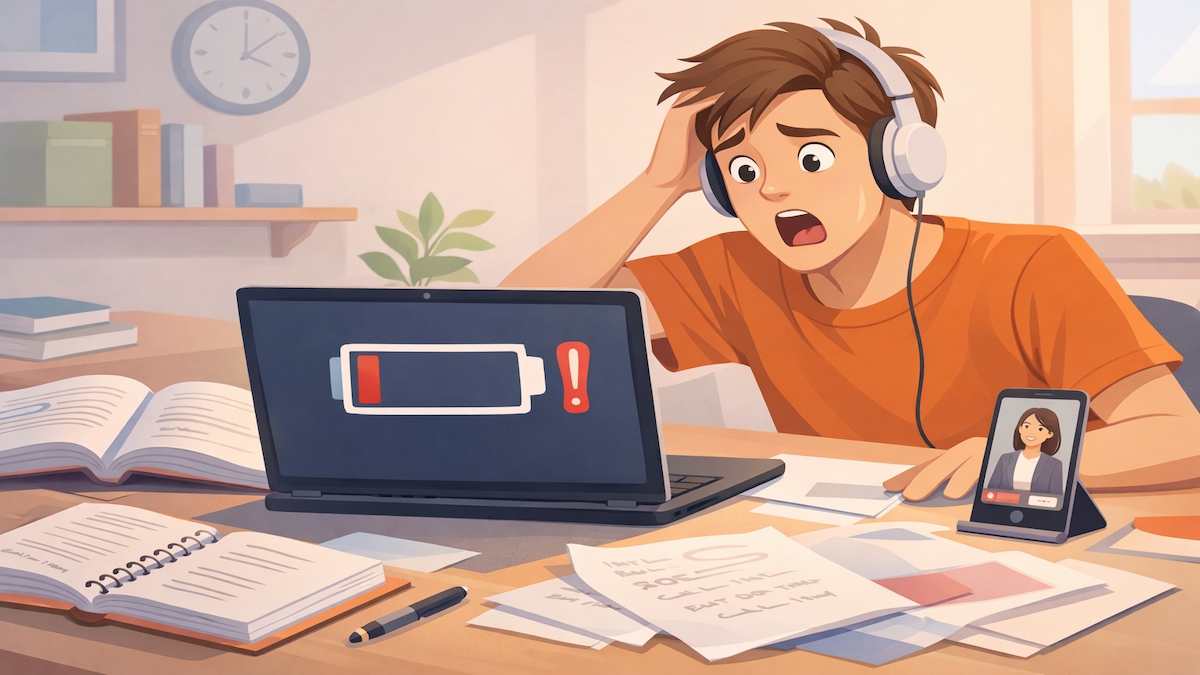 |
| Real-world laptop battery life is almost always less than marketing claims |
Laptop Battery Life Truth: What Marketing Doesn’t Tell You
Choosing a laptop is exciting……
…until it dies at 38% during an online class 😐
Every laptop box screams:
🔋 “Up to 12 hours battery life!”
🔋 “All-day battery!”
But in real life? Yeah… it’s very different.
Let’s clear the confusion once and for all, so you don’t end up hunting for a power outlet mid-lecture-or worse, during a Zoom exam.
Because battery panic at 11% is real, trust me.
🔋 “All-day battery!”
The Big Lie: “Up to 12 Hours” Battery Life
Golden rule:
“Up to” = “under perfect conditions you’ll basically never use.”
Manufacturers test battery life with:
-
Lowest screen brightness
-
Wi-Fi off
-
Local video playback (no multitasking)
-
No background apps
Basically, your laptop is living in a bubble lab, while you’re juggling 15 Chrome tabs, Spotify, and a half-finished assignment.
It’s like expecting you to be a Zen student, meditating quietly while your laptop hums happily. Reality? Not so much.
“Up to” = “under perfect conditions you’ll basically never use.”
Lowest screen brightness
Wi-Fi off
Local video playback (no multitasking)
No background apps
Real-World Laptop Battery Life (The Honest Numbers)

Students usually get far less battery than advertised
Here’s what students really see 👇
Usage Type
Marketing Claim
Real Life
Basic browsing + notes
10 hrs
5–6 hrs
Online classes + tabs
8-9 hrs
4–5 hrs
Coding / multitasking
6-8 hrs
3–4 hrs
Video editing / design
8 hrs
2–4 hrs
Gaming
5-7 hrs
1–2 hrs
Pro Tip: If a laptop says 10 hours, expect roughly half in real life.
It’s like those “family-size” chocolate bars… marketed for five people, but somehow you finish it alone before Netflix even starts.
Or like the “full bottle” shampoo that disappears in a week. Yep, battery life marketing is kinda like that.
|
| Students usually get far less battery than advertised |
| Usage Type | Marketing Claim | Real Life |
|---|---|---|
| Basic browsing + notes | 10 hrs | 5–6 hrs |
| Online classes + tabs | 8-9 hrs | 4–5 hrs |
| Coding / multitasking | 6-8 hrs | 3–4 hrs |
| Video editing / design | 8 hrs | 2–4 hrs |
| Gaming | 5-7 hrs | 1–2 hrs |
Pro Tip: If a laptop says 10 hours, expect roughly half in real life.
Why Laptop Battery Feels Worse Over Time
Ever heard this?
“My laptop battery was amazing when I bought it.”
Fast-forward 6 months, and it’s gasping for power like your grandma’s old scooter.
“My laptop battery was amazing when I bought it.”
1️⃣ Batteries Degrade (Quietly)
Laptop batteries are consumable, not magic energy crystals.
-
After 1 year → ~85–90% capacity
-
After 2 years → ~75–80%
-
After 3 years → noticeable drop

Laptop batteries lose capacity gradually, reducing real-world usage
After 1 year → ~85–90% capacity
After 2 years → ~75–80%
After 3 years → noticeable drop
|
| Laptop batteries lose capacity gradually, reducing real-world usage |
Think of it like a sandcastle. Day 1, perfect. By day 3, waves of heavy usage have eroded it. Batteries degrade the same way.
2️⃣ Software Gets Heavier
Every year:
-
OS grows bigger (hello, storage bloat!)
-
Browsers become power monsters
-
Background services multiply
-
AI features quietly run
Your battery didn’t get worse… the workload increased.
It’s kinda like jogging with a backpack that keeps getting heavier. Not fair, right?
This is similar to why 8GB RAM struggles over time:
OS grows bigger (hello, storage bloat!)
Browsers become power monsters
Background services multiply
AI features quietly run
3️⃣ Screen Brightness Eats Battery
Screen = battery ninja
-
High brightness → drains fast
-
120Hz refresh rate → drains faster
-
OLED panels → gorgeous but thirsty
Marketing tests use very low brightness. You? Not so much.

Bright screens and high refresh rates consume more battery than ads suggest
High brightness → drains fast
120Hz refresh rate → drains faster
OLED panels → gorgeous but thirsty
|
| Bright screens and high refresh rates consume more battery than ads suggest |
Battery Size Matters (Hidden Truth)
Forget marketing hours. Look at:
👉 Battery capacity (Wh – Watt-hours)
Rough guide:
-
40–45 Wh → weak
-
50–55 Wh → average
-
60+ Wh → good
-
70+ Wh → excellent
Two laptops say “10 hours,” but the one with bigger Wh wins.
40–45 Wh → weak
50–55 Wh → average
60+ Wh → good
70+ Wh → excellent
Two laptops say “10 hours,” but the one with bigger Wh wins.
Intel vs AMD vs Apple: Battery Reality
🔹 Intel – decent efficiency, older chips drain faster
🔹 AMD – better efficiency per watt, solid performance
🔹 Apple – amazing optimization, tight hardware-software control
⚠️ Even Apple laptops don’t magically match marketing claims under heavy use.
Fast Charging Isn’t a Miracle
Brands love:
⚡ “50% charge in 30 minutes”
-
Doesn’t increase total battery life
-
More heat = slightly worse long-term health
Doesn’t increase total battery life
More heat = slightly worse long-term health
Biggest Battery Mistakes Students Make
❌ Believing marketing numbers blindly
❌ Ignoring battery capacity (Wh)
❌ Buying ultra-thin laptops with tiny batteries
❌ Thinking replacement is cheap
❌ Forgetting 3–4 year degradation
Same mistakes students make with RAM:
How Much Battery Do Students REALLY Need?
🎓 Student Battery Guide
Student Type
Minimum Real Battery
School students
6–7 hours
College students
7–9 hours
Coding / engineering
8+ hours
Online-only learners
6 hours
Design / media
Plug-in preferred
Aim for one full day without panic.
| Student Type | Minimum Real Battery |
|---|---|
| School students | 6–7 hours |
| College students | 7–9 hours |
| Coding / engineering | 8+ hours |
| Online-only learners | 6 hours |
| Design / media | Plug-in preferred |
Aim for one full day without panic.
One Rule That Actually Works
If a laptop says 10–12 hours, buy it only if you’re okay with 6–7 hours after a year.
Saves:
-
Regret
-
Power-bank panic
-
Early replacement
If a laptop says 10–12 hours, buy it only if you’re okay with 6–7 hours after a year.
Regret
Power-bank panic
Early replacement
Final Verdict: Battery vs Marketing
Marketing = comparison tool, not a promise.
Battery life is always lower. Shrinks yearly.
Smart buyers:
-
Check Wh
-
Read reviews
-
Plan for degradation
-
Buy for future use, not day one
Check Wh
Read reviews
Plan for degradation
Buy for future use, not day one
Final Thought
Battery life is invisible—until you hunt for a plug at 11%.
Marketing sells hope. Understanding saves money.
Choose wisely. Your future self (and charger) will thank you 🔋🙂
FAQs-
Q1: Why does my battery last less than advertised?
A: Labs test under perfect conditions—low brightness, no multitasking. Real life = lower hours.